Life safety generators for student accommodation: lessons from Leeds and Manchester
4 Nov 2026
Purpose built student accommodation has changed. The new blocks going up in Leeds and Manchester are tall, dense and occupied around the clock by people who have never lived away from home before. Firefighting lifts, smoke ventilation, sprinkler pumps, emergency lighting and the fire alarm all have to keep working when the mains fails, and that means a life safety generator. PCAS has installed life safety generators in student accommodation blocks in both cities, working for the main contractors and electrical contractors building them. This is what the job involves and what we have learned doing it.
A life safety generator is not a standby set that happens to feed the lifts. It is part of the fire strategy and it is covered by BS 8519, the standard for fire resistant power and control cable systems for life safety and firefighting applications, alongside BS 9999 and the standards for the systems it feeds. In plain terms it has to:
The loads are typical for a tall residential block: firefighting lifts, smoke extract fans and automatic opening vents, sprinkler or mist pumps where fitted, fire alarm and voice alarm systems, emergency lighting, firefighting shaft pressurisation and the fire service lifts’ landing controls. Add them up with their starting currents and the set is often larger than people expect for a building that has no industrial load at all.
City centre student blocks have no spare land. The generator ends up in a basement plant room, on the roof, or in a dedicated enclosure in a service yard, and each has its problems. A basement needs a fire rated room, ventilation for combustion and cooling air, an exhaust route to roof level and fuel delivery that does not involve carrying drums through reception. A roof needs a crane lift, structural checks and acoustic treatment because the neighbours are at the same height. A yard enclosure needs planning consent and a sound attenuated canopy specified for the night time noise limit.
On the Leeds and Manchester blocks we have worked on, the crane lift and the exhaust route were decided months before the set arrived, and that is the right way round. A generator that turns up before the plant room is ready is the most expensive piece of kit on site to store.
Fuel inside a residential building is tightly controlled. The usual arrangement is a small integral or day tank at the set, sized within the limits the fire strategy allows, fed from a bulk tank outside or in a separate compartment by a pumped transfer system with level controls and alarms. The transfer system is part of the life safety system too, so its controls and power supply need the same protection as the generator. We design and build these fuel transfer control panels alongside the generator controls so they are tested as one system.
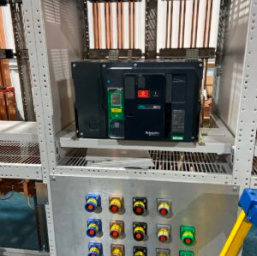
The generator is only as good as the route between it and the firefighting lift. BS 8519 sets out the fire resistance categories for the cables, and the changeover switchgear has to sit where a fire cannot take out both the mains and the generator supply at once. We build the changeover and distribution panels with ComAp automatic mains failure controllers, which give the start and transfer sequence, the engine protection and an event log the fire engineer can read at commissioning. Where the client has several blocks, the controllers are put on remote monitoring so one estates team can see every set from one screen.
Commissioning a life safety set is done in front of the fire engineer, the building control inspector and often the client’s insurer. The test is simple to describe and unforgiving to pass: kill the mains, start the clock, and have every life safety load running on the generator inside 15 seconds, then hold it under full load for long enough to prove the cooling and the fuel system. We produce the test record, the settings file and the operating instructions as part of the handover pack, because the building cannot be occupied until the fire strategy is signed off.
Student blocks are occupied from September to June with a few weeks of turnover in summer, and the generator has to be tested without upsetting several hundred residents. We write the test schedule into the service agreement: a short on load run each month at a quiet time, the annual full load test in the summer gap, batteries, fuel and changeover checked every visit, and a 24/7 callout line for the night a set fails to start. Our engineers cover Leeds and Manchester from regular routes, so a portfolio across both cities is looked after by the same people.
See our generator installation in Leeds and generator installation in Manchester pages, or talk to us about a block you are pricing.
Call 0114 317 7939 or email support@pcasltd.com.
Have a question about this article? Email support@pcasltd.com or call 0114 317 7939.